



 Love
Love

Policy

The 2027 Medicare Physician Fee Schedule for Dermatology: What the "9% Cut" Really Means and What to Do
What the proposed 2027 fee schedule really means for dermatology, why this cut is built differently, and what to do before it lands.


ModMed is the industry's dominant dermatology EMR with deep clinical templates and a mature ecosystem. EZDERM is lighter, faster to implement, and gaining ground with its new EVE AI platform.
Your EMR choice affects billing accuracy, cash flow timing, and long-term vendor flexibility more than any feature checklist reveals.
Both vendors now offer bundled RCM, and both create switching friction that startup practices rarely anticipate until it's too late.
The right platform depends on your charting preferences, staffing plan, and whether you want to own your billing relationship or hand it over with the software.
Your EMR decision is not really a software decision. It's a financial architecture decision — one that shapes how you capture revenue, who controls your billing, and how hard it will be to change course in two years.
We say this as a billing company that works on both ModMed and EZDERM every day, across 200+ dermatology practices in 42 states. We're not selling either platform. We're the team that processes claims, posts payments, and works denials on both. The differences show up in places that feature comparison pages never mention.
Before we get into what each platform looks like from the billing side, here's a quick comparison across the dimensions that matter most for startup practices.
| Dimension | ModMed (EMA) | EZDERM |
|---|---|---|
| Positioning | Full-suite platform for specialty practices | Dermatology-built EMR by a practicing dermatologist |
| Interface | iPad-native, touch-based charting | 3D body map with 3,000+ anatomical locations; iPad and iPhone app for charting |
| Charting approach | Template-driven with auto-suggested billing codes | Template and avatar-based with SNOMED-linked ICD-10/CPT |
| AI features | Scribe 2.0 ambient documentation (750M+ encounters) | EVE AI ecosystem (chart prep, RCM automation) |
| Cost range | $300-$450/provider/month | $250-$450/provider/month |
| Best fit | Practices wanting a mature, all-in-one ecosystem | Startups and solo practitioners prioritizing speed and simplicity |
| Implementation | Structured: ModMed U + live training, lab connectivity up to 10 weeks | Faster ramp, fewer moving parts, lighter lift for small teams |
| Bundled RCM | BOOST (full-service, pricing undisclosed) | EVE RCM Core (automation) and Complete (full-service) |
| Market presence | Black Book #1 dermatology EHR for 13 consecutive years | 4,795+ active locations worldwide |
Aggregated review ratings:
| Platform | ModMed | EZDERM |
|---|---|---|
| G2 | 4.5/5 (329 reviews) | Not enough reviews for a score |
| Capterra | 4.4/5 (135 reviews) | 5.0/5 (26 reviews) |
A note on these numbers: ModMed's ratings come from hundreds of verified users and carry statistical weight. EZDERM's perfect 5.0 on Capterra is based on just 26 reviews, and a handful of negative experiences would meaningfully shift that average. Both platforms have satisfied users, but don't read too much into a 4.4 vs. 5.0 gap when the sample sizes are this different.
ModMed has been the default choice in dermatology for over a decade. Black Book Research has ranked it #1 in dermatology EHR for 13 consecutive years, based on surveys of 33,000+ user responses. When practices ask peers what they use, ModMed comes up more than anything else.
Source: G2
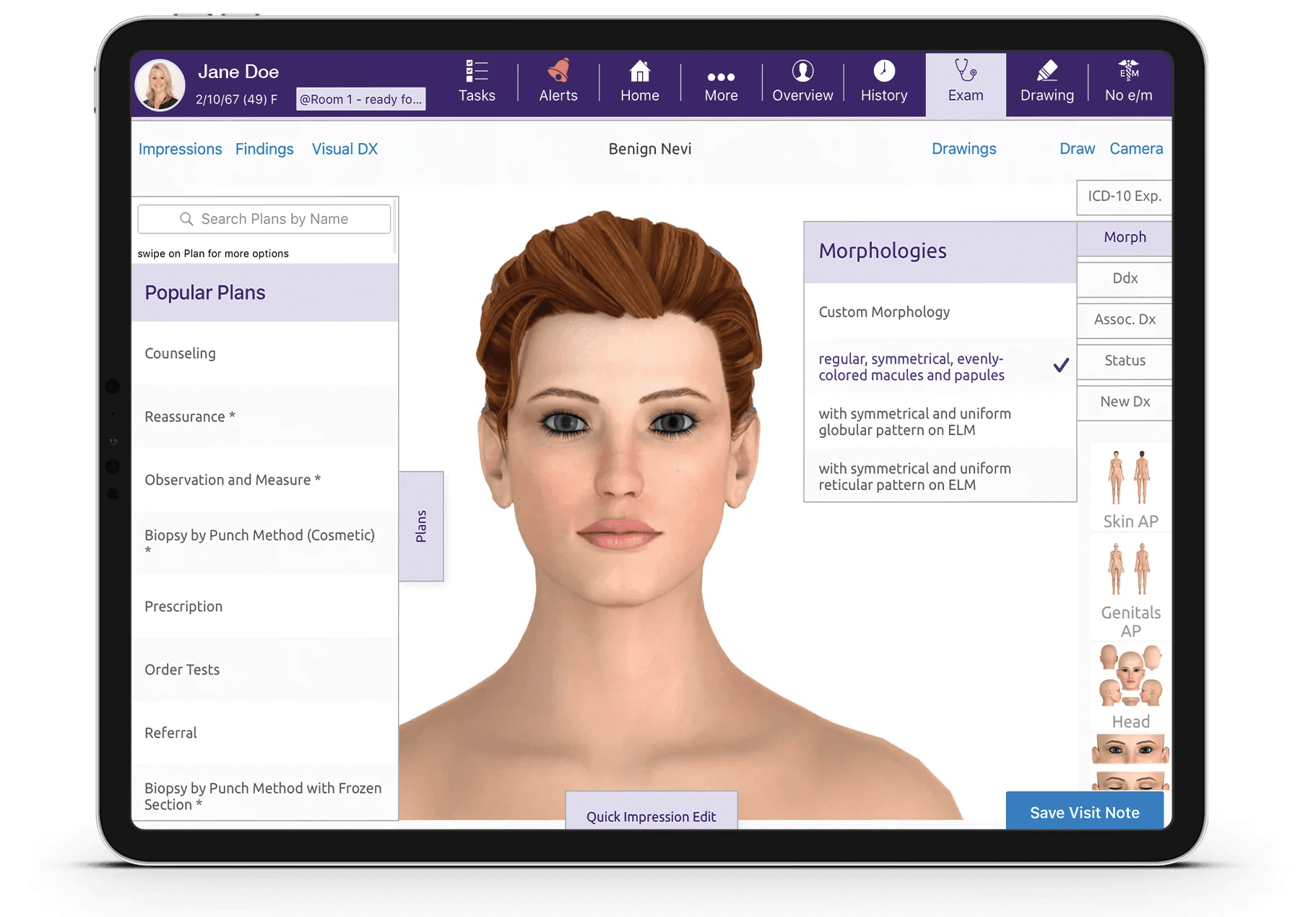
The platform runs on iPads with touch-based charting that most providers learn to move through quickly. Auto-suggested billing codes pull from template selections, and note finalization can happen same-day, which matters because notes that sit open are notes that aren't generating claims.
ModMed's integration between the EHR and practice management (PM) modules is where the real value sits for established practices. Scheduling, eligibility checks, claim submission, and payment posting all live in one system. For a practice running at volume, this reduces handoff points between clinical and administrative staff.
The newest addition is ModMed Scribe 2.0, an ambient clinical documentation tool trained on 750 million+ de-identified patient encounters. It listens during the visit and auto-suggests prescriptions, lab orders, and diagnoses from approved notes. A Clinical Assistant module for pre-encounter patient history summaries is expected in the second half of 2026.
Staff familiarity is a genuine advantage. When you hire a medical assistant or front-desk coordinator who has worked in dermatology before, there's a good chance they already know ModMed. That shortens your onboarding window.
ModMed is a big system. For a startup practice with one or two providers, that size can work against you.
Cost: At $300-$450 per provider per month, plus first-year implementation fees that can run $6,000-$15,000 per provider including template customization and training, ModMed is the premium option. That's real money when you're simultaneously covering build-out costs, credentialing delays, and the slow ramp of a new payer panel.
Complexity: User reviews on G2 consistently mention a steep learning curve and significant initial setup time. The workflow build is extensive. If you don't have a dedicated super-user on staff who owns the configuration, things can get messy.
Reporting: Several recent reviews flag slow analytics, no auto-delivery of reports, and limited third-party BI integration. For practices that want custom reporting beyond what ModMed's built-in dashboards provide, this can be a frustration.
None of this means ModMed is wrong for startups. It means you should go in knowing the full commitment.
EZDERM was built by a practicing dermatologist, and that origin story still shapes the product. It's a lighter system designed around how dermatologists actually examine patients, not how software engineers think they should.
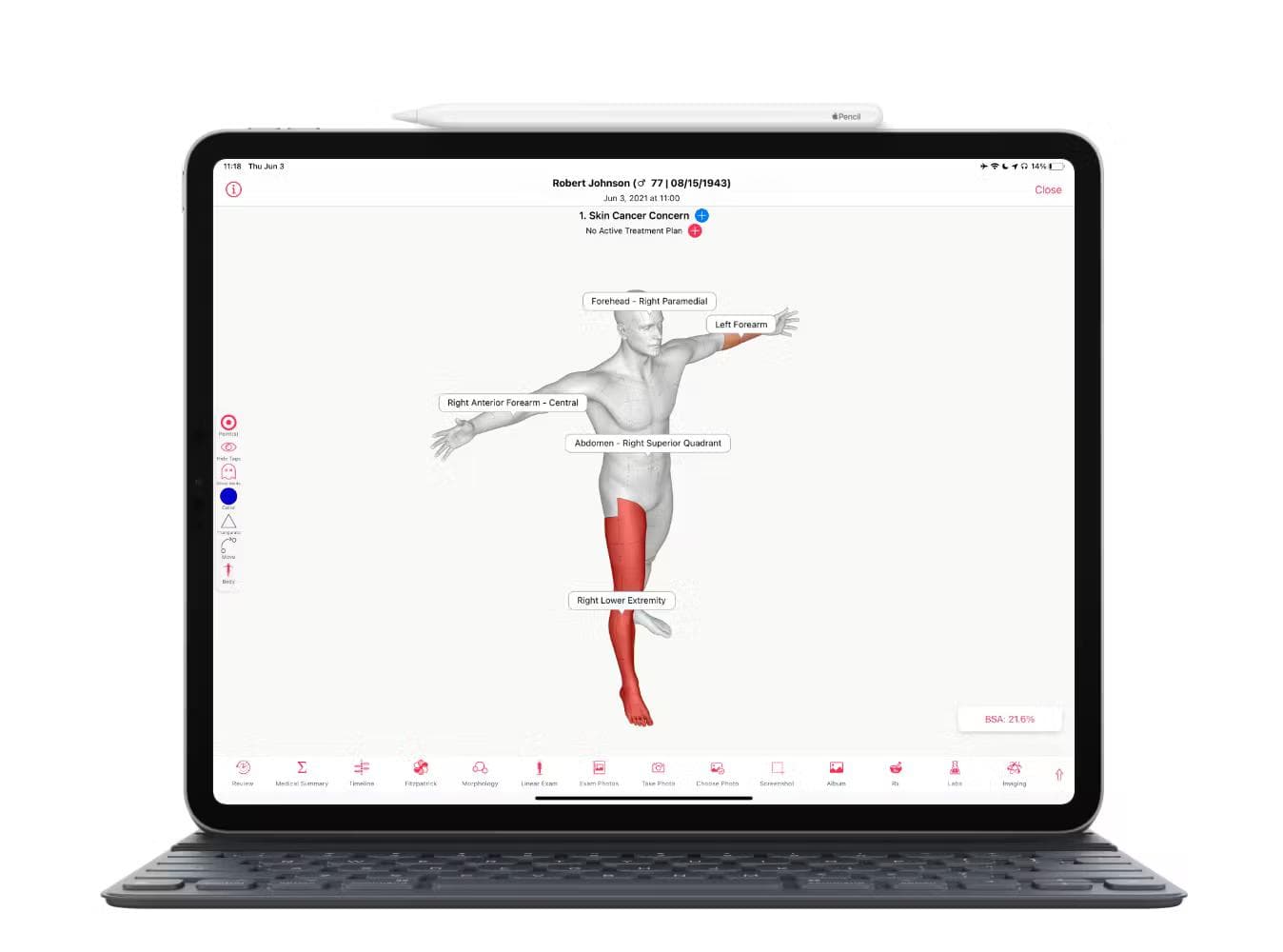
Source: Capterra
The defining feature is the 3D body map with over 3,000 anatomical locations. Instead of selecting from template dropdowns, providers tap directly on a virtual body to document lesion location and size. This maps to ICD-10 and CPT codes through a SNOMED database, so the clinical documentation and the billing codes are linked from the point of charting.
For procedures like mole mapping and Mohs surgery documentation, the visual approach can be faster and more precise than text-based templates. Clinical research supports 3D mapping for improving localization accuracy and patient communication.
EZDERM runs on both iPhone and iPad, which gives providers more flexibility in how they move between exam rooms. Implementation tends to be faster for small practices because the system has fewer configuration layers.
The biggest recent development is the EVE AI ecosystem, announced January 2026 and launched at AAD in March 2026. EVE includes automated chart prep (condensing past encounters into summaries), plus two tiers of RCM support: an automation-only Core tier and a full-service Complete tier with dermatology-certified billers.
User reviews across Capterra and GetApp consistently praise EZDERM's customer support as "incredible" and "best in class." For a startup practice without dedicated IT, responsive vendor support can make or break the first six months.
EZDERM's simplicity is its strength — and its ceiling.
Reporting: The platform's analytics are more limited than ModMed's. Practices that grow into multi-provider groups often need third-party data overlays (Power BI, Tableau, or custom dashboards) to get the operational visibility they need.
Integration ecosystem: ModMed has a wider network of certified API connections, lab interfaces, and third-party integrations. EZDERM's ecosystem is smaller. If your practice growth plan involves complex lab connectivity, hospital interface referrals, or GPO integrations, map those requirements against what each platform actually supports, not just what they list on a features page.
ICD code depth: Some users note that EZDERM's ICD code library doesn't cover every dermatology-specific scenario. For high-volume practices doing complex coding (cosmetic/medical splits, multiple modifier stacking, global period tracking), the template options may need supplementation.
Here's where most comparison articles stop: feature lists, screenshots, pricing. But the EMR decision goes deeper than the software itself.
Your EMR determines how clinical information is captured, coded, and transmitted. That data is the raw material your billing team works with. A platform that produces clean, complete, properly coded encounters on the first pass saves time and money downstream. A platform that requires manual correction, code stacking adjustments, or supplemental documentation after the fact costs you, even if the software itself is cheaper.
Both ModMed and EZDERM now offer their own bundled RCM services. ModMed has BOOST. EZDERM has EVE RCM. Both pitch the simplicity of a single vendor handling everything.
That pitch sounds good. In practice, more than 60% of hospital CFOs report that EHR/RCM integration challenges outweigh the benefits. And the reasons apply to practices of any size:
When a practice's EMR vendor is also its billing vendor, there's no competitive pressure on RCM performance. The vendor doesn't need to earn the billing business separately because it's already part of the software deal. If denial rates creep up or A/R ages, the only option is to ask the same vendor to fix itself. There's no independent partner to benchmark against.
Switching costs compound. If you bundle EMR and RCM and later want to change billing companies, you're often looking at disrupting the entire platform. Some vendors structure contracts so that leaving RCM means renegotiating your EMR terms. Industry experts recommend separating EMR and RCM precisely to maintain this flexibility.
This doesn't mean bundled RCM is always wrong. It means you should understand what you're giving up before you sign. Clarity RCM integrates with both ModMed and EZDERM, so the billing decision stays independent of the EMR decision.
These are patterns we see across practices running on both platforms. Not marketing claims, but actual workflow friction that shows up in billing performance.
Both ModMed and EZDERM suggest billing codes based on documentation. That's helpful. But auto-suggested codes are not the same as certified-coder-reviewed codes.
We routinely see practices relying on EMR-suggested codes without a second review. The result: systematic over-coding (which triggers audits and recoupment demands) or under-coding (which leaves money on the table with every claim). Neither platform's auto-coding replaces a trained dermatology coding team that understands modifier rules, global period tracking, and payer-specific documentation requirements.
The fix isn't a better EMR. It's a billing workflow that includes a human review step between clinical documentation and claim submission. That step is where independent billing teams add the most value.
EZDERM's mobile workflow lets providers chart from anywhere in the office, which is great for patient throughput. But we see a downstream effect: when the provider finishes the encounter on their phone in the hallway, the front desk doesn't always know the visit is complete. Checkout gets delayed. Copay collection gets missed. Patient flow stalls.
This is a workflow gap, not an EZDERM design flaw. It needs to be closed with process, not software. Practices that set up explicit "encounter complete" signals (even a simple status indicator on the schedule) avoid this.
ModMed has an integrated pathology module that tracks specimens from biopsy through results. EZDERM handles pathology, but the tracking is less automated. Practices on EZDERM are more likely to need manual follow-up processes to ensure every specimen has a result and every result triggers the appropriate patient communication and billing action.
For dermatology, where biopsy volume is high and missed pathology follow-ups carry both clinical and legal risk, this is a meaningful operational difference.
Every comparison article gives you the same recommendation: ModMed for big practices, EZDERM for small ones. That's not wrong, but it's not useful either. Here's how we'd frame it based on what we actually see.
Choose ModMed if:
Choose EZDERM if:
And here's what both camps should know: Your needs will evolve. The EMR that's right for a solo startup in year one might not be what you need as a five-provider group in year three. That's normal growth, not a reflection of a poor initial choice. What matters is that you don't lock yourself into a vendor relationship that makes the next move harder than it needs to be.
Nobody picks an EMR thinking about how they'll leave it. But switching happens. Practices merge, outgrow systems, or decide they need different capabilities. When it does, the real costs surprise people.
Direct migration costs run $10,000-$50,000, depending on practice size, data volume, and how the old system structures exports. Data portability remains a challenge: structured data like demographics and schedules transfers cleanly, but clinical images, lesion tracking history, and before-and-after photos often require manual rework.
Expect 2-4 weeks of reduced productivity during the transition. Dual-entry periods, staff retraining, and workflow rebuilds take time even with the best project management.
Historical A/R doesn't transfer automatically. Open claims, pending denials, and aged balances in your old system need to be worked through to resolution. They don't follow you to the new platform. This is where having an independent billing partner pays for itself. Your billing team stays constant even when the EMR changes. Claims in progress don't fall through the cracks. Revenue continuity isn't interrupted because your A/R management isn't tied to the software.
We've managed this transition for practices moving in both directions — from ModMed to EZDERM and from EZDERM to ModMed. The practices that have the smoothest migrations are the ones whose billing operations aren't coupled to their EMR vendor. Specialty-specific denial management stays consistent through the transition because it's handled by the billing team, not the software.
Q: Which EMR is better for Mohs surgery documentation?
A: Both handle Mohs, but differently. ModMed uses structured templates with a dedicated Mohs module that tracks each stage through the procedure. EZDERM's 3D body map offers visual mapping that some Mohs surgeons prefer for documenting excision margins and reconstruction. The best choice depends on your Mohs volume and how you want to visualize cases. Either way, accurate Mohs billing requires a coder who understands the specific CPT layering. That's a billing function, not an EMR function.
Q: Can I use ModMed or EZDERM without their billing services?
A: Yes. Both platforms function as standalone EMR/PM systems. Neither requires you to use their bundled RCM. Many of the 200+ practices we support run ModMed or EZDERM for clinical documentation and practice management while using an independent billing team for revenue cycle management. This keeps your EMR and RCM decisions separate, which gives you more flexibility if either relationship needs to change.
Q: Is EZDERM harder to customize?
A: EZDERM describes its workflows as 100% customizable, though the configuration depth is narrower than ModMed's. ModMed has more template variations and configuration layers, which means more flexibility but also a longer setup process. For most startup practices, EZDERM's out-of-the-box configuration covers the standard dermatology workflow. Customization depth becomes more important as practices add subspecialties, clinical trials, or high-volume cosmetic services.
Q: How much does dermatology EMR software cost?
A: Expect $250-$450 per provider per month for either platform, depending on your tier and negotiated terms. First-year costs are higher because of implementation, template customization, and training. Budget $6,000-$15,000 per provider for year one with ModMed, and somewhat less for EZDERM given the lighter implementation. Cloud-based pricing is now standard; over 85% of dermatology practices use cloud-deployed EMR systems.
Q: Which EMR is best for a startup dermatology practice?
A: There's no universal answer. EZDERM generally offers a faster, less expensive path to go-live for solo or small startup practices. ModMed is a stronger long-term bet if you're planning rapid growth and want to minimize the chance of outgrowing your system. Both are viable. The bigger risk for startups isn't picking the wrong EMR — it's bundling your EMR and billing decisions together before you've had enough operating history to know what good billing performance looks like for your practice.
Clarity RCM supports 200+ dermatology practices across 42 states, running on every major EMR platform including ModMed and EZDERM. If you're opening a practice and want to talk through how your EMR choice connects to outsourced dermatology billing performance from day one, reach out for a billing assessment. We'll give you the same honest assessment whether you're on ModMed, EZDERM, or still deciding.
Practical reads on billing, coding, payers, and the business of running a
dermatology practice, from the team working in it every day.